BFF Friendship Test
- 4.4
- Rating
- 10.00M
- Installs
- Free
- Price

 Analysis by App-foxy
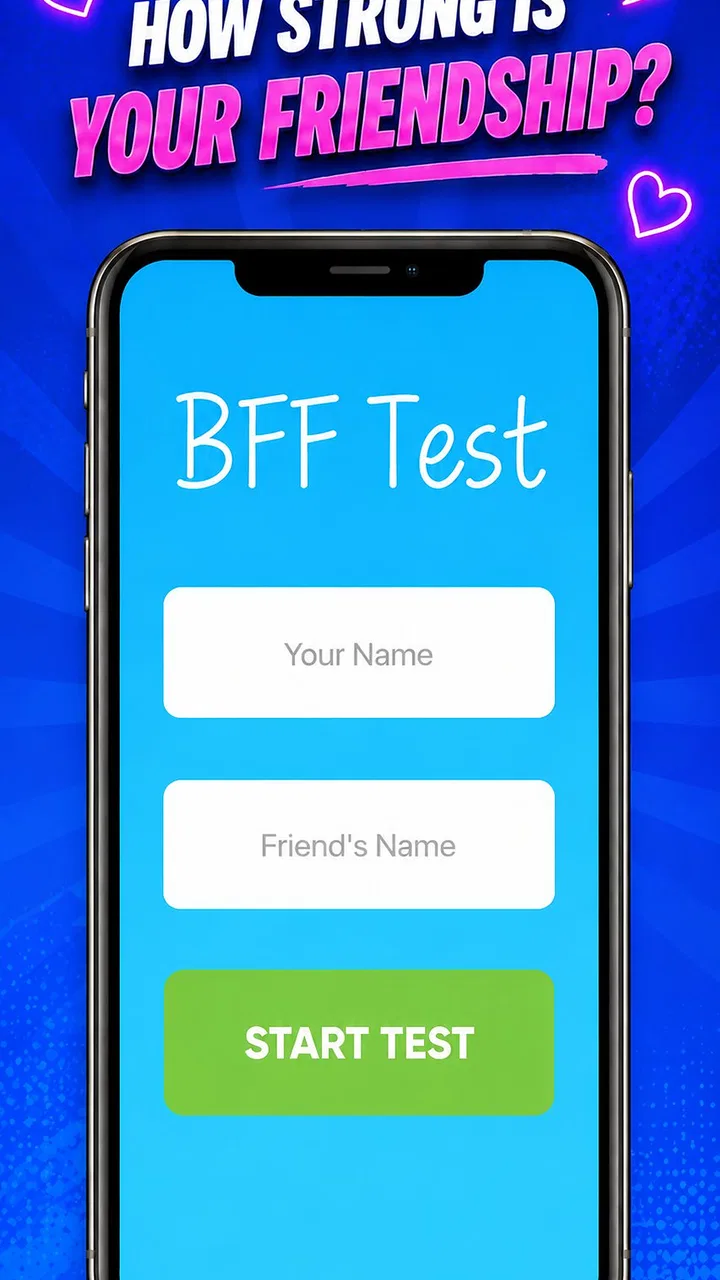
I tried BFF Friendship Test as the kind of quick trivia game you open when friends are together and nobody wants to explain complicated rules. Its idea is simple: answer questions about your friendship, compare your answers, and see how closely your memories, preferences, and expectations line up. That makes it much more social than a normal solo quiz, even though the basic interaction is easy to understand immediately.
Developed by DH3 Games, this free trivia game is aimed at casual groups rather than serious quiz competitors. It is rated for Everyone, runs on Android 6.0 or later, and has been available since April 2, 2017. The current version is 15.1.0, so it is not a brand-new experiment that has just appeared in the store. It has reached over 10 million installs, with a 4.4 average from around 64 thousand ratings and roughly 7.4 thousand written reviews.
Those figures suggest that the format has found a large audience, but they do not tell me whether every question will suit every friendship. My experience is that the game works best when you treat it as a conversation starter, not as a scientific measurement of how close two people are. The result can be funny, revealing, or occasionally awkward, depending on who is playing and how seriously they take the answers.
You May Also Like

 AccuWeather: Weather Radar
AccuWeather Review: A Quick, Clear Forecast for Everyday Decisions
For everyday plans, the best forecast is the one you can understand quickly. AccuWeather makes rain timing, radar, and local conditions easy to act on, with a few trade-offs.

 Hill Climb Racing
Why Hill Climb Racing Still Turns Crashes Into One More Run
A tiny car, a bumpy hill and one more upgrade: Hill Climb Racing keeps resurfacing because its simple chaos makes every near-miss feel personal.

 AliExpress - Shopping App
AliExpress Makes Global Shopping Feel Personal, but Shoppers Bear the Risk
AliExpress turns a global marketplace into a pocket-sized discovery engine. Its reach is useful, its shopping loop compelling, and its trade-offs easy to miss.

 Lords Mobile: Kingdom Wars
Lords Mobile Is a Kingdom-Building Routine, Not a Quick Match
A case-by-case verdict on the building, battles, device demands, and social commitments that make Lords Mobile rewarding for some players and exhausting for others.

 PDF Scanner app - TapScanner
TapScanner Makes Paperwork Easier to Capture, Check, and Share
TapScanner makes scanning with a phone feel less like a rescue operation and more like a dependable step in getting work done. Its capture tools are useful, though not flawless.

 Block Blast!
 Shows How Much a Puzzle Game Can Leave Out
A quiet grid game shows why puzzle players increasingly value instant clarity, repeatable skill and low-pressure play—and where the genre still needs to catch up.
More From Our News Desk
View All News


How the friendship quiz feels in everyday use
I find the quiz easiest to enjoy when I treat it as a short social activity rather than a measure of anyone’s worth as a friend. In everyday use, the best moments often come from pausing over an unexpected answer and hearing the story behind it. That makes the way a group handles busy or high-energy sessions worth considering next.
A low-effort game for real social moments
The strongest use case is a relaxed moment with a close friend, sibling, partner, or small group. Imagine waiting for food, sitting together during a quiet evening, or looking for something to do during a journey. One person can bring up the quiz, and the others can answer without needing a long tutorial or a large time commitment. That instant accessibility is more important here than deep game mechanics.
I would not choose it for a planned game night where everyone expects a long, strategic experience. It is better at filling short gaps than carrying an entire evening. The questions provide a reason to talk, but the conversation around an answer is often more entertaining than the score itself. If someone answers differently from what you expected, the natural next step is to ask why, and that is where the app becomes genuinely useful.
There is also a practical advantage in its simplicity. Players do not need to know trivia categories, memorize rules, or prepare materials. A person who normally avoids quiz games can still understand the purpose quickly because the subject is personal rather than academic. That makes it more approachable than a general knowledge app when the group wants something playful instead of competitive.
What the score can and cannot tell you
The central idea sounds more precise than it really is. A friendship score can reflect how similarly two people answer a set of prompts, but it cannot measure loyalty, kindness, trust, or how someone behaves when a friend needs help. I found it healthier to read the result as a snapshot of shared knowledge and expectations. A low outcome may simply mean that the questions touched on details one person has never discussed.
This distinction matters if you are playing with someone you care about. A quiz can accidentally turn a harmless mismatch into a judgment. If one player remembers a favorite food and the other does not, that may be funny. If the game asks something emotionally sensitive, the same format could feel more personal. I recommend agreeing before starting that the result is for entertainment and that nobody has to defend an answer they would rather keep private.
A useful habit is to pause after surprising answers instead of rushing to the final result. Ask whether the question was unclear, whether both people interpreted it differently, or whether one answer has changed over time. That turns the game from a pass-or-fail test into a small way of learning something new about a friend. It also reduces the pressure created by the word “test” in the title.
Using it without creating unnecessary pressure
The game is most enjoyable when everyone has permission to laugh at the mismatch. I would avoid presenting it as proof that one friendship is stronger than another, especially in a group where people may compare scores publicly. The format invites comparison, but comparison is not always fair because different friendships have different histories and levels of familiarity.
For example, a childhood friend may know your old habits while a newer friend understands your current interests better. A sibling may know family memories but not your private preferences. A partner may be expected to know more, which can make a playful result feel like criticism. The same quiz therefore has different emotional weight depending on the relationship.
My practical approach is to let the person being tested decide how much detail to share. If an answer leads to a disagreement, I would treat the disagreement as the content of the game rather than evidence of a problem. This is one of the less obvious strengths of the format: it gives people a structured excuse to discuss things they might not normally ask each other directly.
Fairness between different kinds of friendships
Fairness is complicated because the game appears to compare friendships using the same kind of result, while the players may not have had the same opportunity to learn about one another. A long friendship naturally gives people more shared memories. A newer friendship may still be meaningful but contain fewer established answers. The score can favor familiarity without necessarily reflecting emotional closeness.
There is another issue: personal questions are not automatically objective questions. Two players may understand words such as “favorite,” “best,” or “most likely” in different ways. One person may choose a current preference while another chooses a lifelong favorite. If the game does not make that distinction clear, a mismatch may be caused by wording rather than by a lack of knowledge.
That is why I would not use the result to settle an argument or rank several friends. It works better as a shared prompt set. If you want a fairer comparison, use the same relaxed conditions for everyone, avoid coaching one player while another is answering, and discuss ambiguous questions openly. Even then, the outcome should remain a playful indicator, not a verdict.
How it compares with ordinary trivia alternatives
Compared with a standard general knowledge quiz, this game has a narrower but more personal appeal. Traditional trivia tests what players know about history, science, entertainment, or geography. Here, the relevant knowledge is about the people in the room. That makes it less useful for someone who wants a clear right-or-wrong challenge and more useful for someone who wants conversation.
It also differs from party games built around drawing, acting, or fast reactions. Those alternatives usually reward performance and group energy. This format rewards attention to personal details. A quiet pair can enjoy it without needing a large audience, while a loud group may find that the questions become a starting point for teasing and storytelling.
On the other hand, a conventional quiz may feel fairer because every player receives the same factual topic and can improve through knowledge. A friendship quiz has a more subjective foundation. If your group enjoys strategy, timed rounds, or a strong sense of progression, another trivia game will probably provide more depth. If your priority is finding out whether a friend remembers the small things about you, this is the more relevant choice.
Spending, access, and what I would check first
The game is free to download, which makes it easy to suggest spontaneously without asking everyone to commit money before trying it. That is particularly helpful in a group: one person can introduce it, and the others can decide whether the format suits them. The free entry point supports the casual nature of the experience.
I would still keep expectations sensible about spending. The information available for this game confirms that it is free, but it does not establish a complete picture of every possible purchase or whether any optional paid elements appear during use. I would therefore check the current store screen and the in-app prompts on my own device before handing the phone to a child or using it in a group that wants a completely purchase-free session.
That is not a criticism of this particular game; it is a sensible step for any free mobile title. A free download can be convenient, but the important question is whether the way it presents optional spending fits your situation. For an adult using it casually with friends, this is usually a quick check. For a family device, I would also review the device’s purchase protections rather than relying only on the word “free.”
Questions I would consider before installing
If you are wondering whether it works for a couple, I think it can, provided both people enjoy playful personal questions. It may be less comfortable when one person expects the result to prove something serious. For siblings or longtime friends, the shared history can make the questions more entertaining, although old memories may also produce arguments about what really happened.
If you are choosing it for children, the Everyone rating makes it broadly accessible, but an age label does not replace supervision or common sense. Children can take friendship comparisons seriously, especially when one person gets a higher result. I would encourage them to discuss answers kindly and avoid using the score to exclude someone from a group.
If you want to play offline, I would test that before planning a trip or event around it. A store description can explain the purpose of a game without guaranteeing that every part of the experience behaves the same way without a connection. The safest workflow is to open it once in the environment where you expect to use it, rather than discovering a limitation when the group is already waiting.
If you are looking for lasting progression, this is probably not the right first choice. The appeal comes from the people and the questions, not from building a long-term competitive profile. I would choose a more structured trivia game for repeated solo sessions, visible advancement, or a stronger challenge curve.
Finally, if you dislike personal comparison altogether, skip it. The game’s subject is friendship, so even harmless questions can feel intrusive when the group is not comfortable. There is no benefit in forcing a social quiz onto people who would rather play a neutral knowledge game.
Small techniques that make the session better
One useful technique is to separate the answer from the explanation. Let each player choose first, then discuss the reasoning. If everyone explains before committing, the group may unintentionally influence the result. Keeping those moments separate makes the comparison more honest while still leaving room for conversation afterward.
I also recommend treating an uncertain answer as information rather than failure. If a friend hesitates, that may show that the question concerns a preference that has changed. Instead of pushing for a confident response, ask whether the answer depends on the situation. This works especially well with questions about favorites, habits, or hypothetical choices, where a single fixed answer may be artificial.
For groups, a rotating host can improve the experience. Each person gets a chance to answer about someone else, rather than allowing one player to control every question and reaction. It also prevents the session from becoming an examination of one person. The more evenly the attention is shared, the less likely the score is to feel like a public ranking.
Another worthwhile trade-off is deciding whether to chase a higher result. Repeating a quiz can improve familiarity with the expected style of questions, but it may also reduce the surprise that makes the first session fun. I would replay it when a new friend joins or when an earlier answer leads to a good conversation, not simply to manufacture a better number.
My trust verdict after using the format
DH3 Games has made a focused, approachable trivia game for people who want to test how well friends know one another. Its large install base and strong average rating show that the concept has broad appeal, while the free price removes the biggest barrier to a casual trial. The game is easy to recommend when the goal is laughter, conversation, and a little friendly surprise.
My reservation is not about the basic idea but about how seriously players may interpret it. The result is not a complete assessment of a friendship, and the fairness of any comparison depends on wording, shared history, and the expectations brought into the room. It also is not the best replacement for a deep trivia title, a strategic party game, or a long-term solo challenge.
I would recommend it to friends who enjoy personal quizzes and can accept an imperfect score without turning it into an argument. I would skip it for a group that wants strict factual fairness, detailed progression, or a completely neutral subject. Used with the right attitude, BFF Friendship Test is a pleasant social tool: not a serious friendship meter, but a simple excuse to ask questions, remember details, and discover that even close friends can still surprise each other.
FAQs for BFF Friendship Test
01What is the BFF Friendship Test app and how does it work?
The BFF Friendship Test app is a fun and interactive application designed to test the strength and compatibility of friendships. Users answer a series of questions about their friends, and the app calculates a friendship score based on the responses. It's a light-hearted way to engage with friends and learn more about each other's preferences and habits.
02Is the BFF Friendship Test app free to use, or does it require a purchase?
The BFF Friendship Test app is free to download and offers a variety of features at no cost. However, it may include optional in-app purchases that unlock additional features or remove ads. It's important to check the app's store listing for specific details on pricing and available packages.
03What type of questions does the BFF Friendship Test include?
The app includes a wide range of questions that cover different aspects of friendship, such as personal preferences, shared experiences, and hypothetical scenarios. These questions are designed to be fun, engaging, and thought-provoking, helping users discover new facets of their friendships in an entertaining way.
04Can I share my BFF Friendship Test results on social media?
Yes, the BFF Friendship Test app typically offers options to share your results on various social media platforms. This feature allows you to engage with a broader audience and invite more friends to participate in the fun. However, always check your privacy settings before sharing personal information online.
05Is the BFF Friendship Test app suitable for all ages?
The BFF Friendship Test app is generally suitable for a wide audience, including teenagers and adults. However, parents should review the app's content and privacy policies to ensure it aligns with their family’s values, especially if younger children will be using it. The app store's age rating can also provide guidance on its appropriateness.
Pros
- Fun quizzes to test friendship bonds.
- Simple and intuitive user interface.
- Wide variety of quiz topics available.
- Can be played in groups for more fun.
- Easy sharing options for results.
Cons
- Limited customization of quiz questions.
- Ads can be intrusive at times.
- Requires internet connection to play.
- Some quizzes are too short.
- In-app purchases for additional content.

BFF Friendship Test
Gallery